
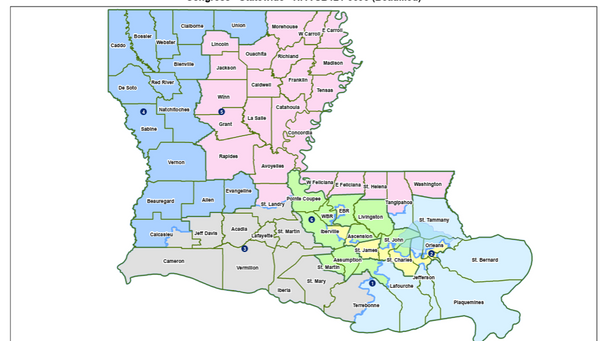

After years of litigation, two rounds of Supreme Court oral arguments, and a landmark ruling that reshaped redistricting law across the country, Louisiana's Legislature is finally doing what the highest court in the land said it must do: draw a congressional map based on sound, race-neutral principles rather than racial quotas. The Beaullieu map — HFA SB121-5695, now before the Louisiana House — does exactly that. It is a good map. It is a fair map. And most importantly, it is the law.
On April 29, 2026, the United States Supreme Court issued its decision in Louisiana v. Callais — a 6-3 ruling that cannot be dismissed or wished away. The Court held that Louisiana's previous congressional map, SB8, was an unconstitutional racial gerrymander. The Legislature had drawn that map specifically to create a second majority-Black district, and the Court found that race had been used as the predominant factor in a way that violated the 14th Amendment. The Court went further, holding that Section 2 of the Voting Rights Act did not require — and could not legally justify — forcing Louisiana to use race as the basis for redrawing its districts. At every step of the Gingles framework, the Court found the challengers had failed to make their case: they did not produce an illustrative map meeting the state's nonracial goals, and their partisan analysis failed to account for political preferences independent of race. In short, the previous map was unconstitutional. The Beaullieu map is the Legislature's constitutionally sound response.
What the map actually does is straightforward. It returns Louisiana's congressional districts to a configuration that closely mirrors the 2022 pre-litigation baseline — a map drawn before federal courts began imposing race-based mandates on the state. District 2, anchored in New Orleans and stretching toward Baton Rouge, remains the state's majority-Black congressional district. Rep. Troy Carter's constituents continue to have meaningful representation, and minority voters in southeast Louisiana retain a district where they can elect a candidate of their choice. The Beaullieu map does not eliminate minority representation — it preserves it in its legally appropriate form. The remaining five districts — covering northwest Louisiana anchored in Shreveport, the central and northeast regions around Monroe and Alexandria, Acadiana and the southwest, the coastal Gulf communities, and the greater Baton Rouge and Florida Parishes corridor — reflect the state's natural geographic, economic, and community-of-interest divisions.
They are compact, contiguous, and drawn around communities that share real economic and civic concerns: oil and gas country, agricultural parishes, coastal communities dependent on fishing and tourism, and the diverse metro areas of the state's interior.
Critics will claim this map is unfair. But fairness in redistricting is not a synonym for mandated racial outcomes. A fair map is one that follows the law, respects traditional redistricting criteria, and reflects the actual partisan composition of the electorate. Louisiana is a deeply conservative state — President Trump carried it by 22 points in 2024. A congressional delegation that is heavily Republican is not evidence of manipulation. It is evidence that the map reflects the voters. When a court-ordered racial gerrymander artificially inflates Democratic representation beyond what partisan geography would otherwise produce, that is not fairness. That is engineering. The Beaullieu map lets Louisianans vote on geography, community, and shared interest — not race.
The clock is running. The legislative session ends June 1, and the state needs a compliant map before the November elections. The redistricting frenzy triggered by Callais is happening across the South, and every day of inaction is a day closer to uncertainty for candidates, parties, and the voters who deserve to know which district they live in. The Senate passed SB121 on a 27-10 vote. The House should follow suit. Beaullieu has indicated the map's overall shape will be preserved even if minor amendments are considered — and that is the right approach. The core of this map is sound, court-compliant, and ready to serve Louisiana for the elections ahead.
For years, Louisiana's congressional map was the subject of endless litigation, federal court orders, and a Supreme Court remand. The state was forced to operate under a map that the highest court has now ruled was drawn unconstitutionally around race. Callais ends that era. The Beaullieu map begins a new one — built on the right foundation. Louisiana deserves a congressional map that follows the Constitution, reflects its voters, and puts the years of court-imposed racial line-drawing behind it. HFA SB121-5695 does all of that. Pass the map. End the litigation. Let Louisiana voters decide.